Home » New Hampshire Bar Foundation » Civics Essay Contest
Civics Essay Contest
The essay submission deadline has closed. Thank you to all the students that submitted essays. We are pleased to announce the 2026 winners in the following press release.
Meet the 2025-2026 Essay Contest Winners
The essay submission deadline has closed. Thank you to all the students that submitted essays. The 2026 winners will be announced in March. Please check back for more information.
A press release announcing the contest winners can be accessed here.
Information on the 2025-2026 contest will be available in the fall.
First Place

Vaibhav Rastogi
Senior receiving his education in person through Bishop Brady High School and virtually through Virtual Learning Academy Charter School.
Watch the Ceremony
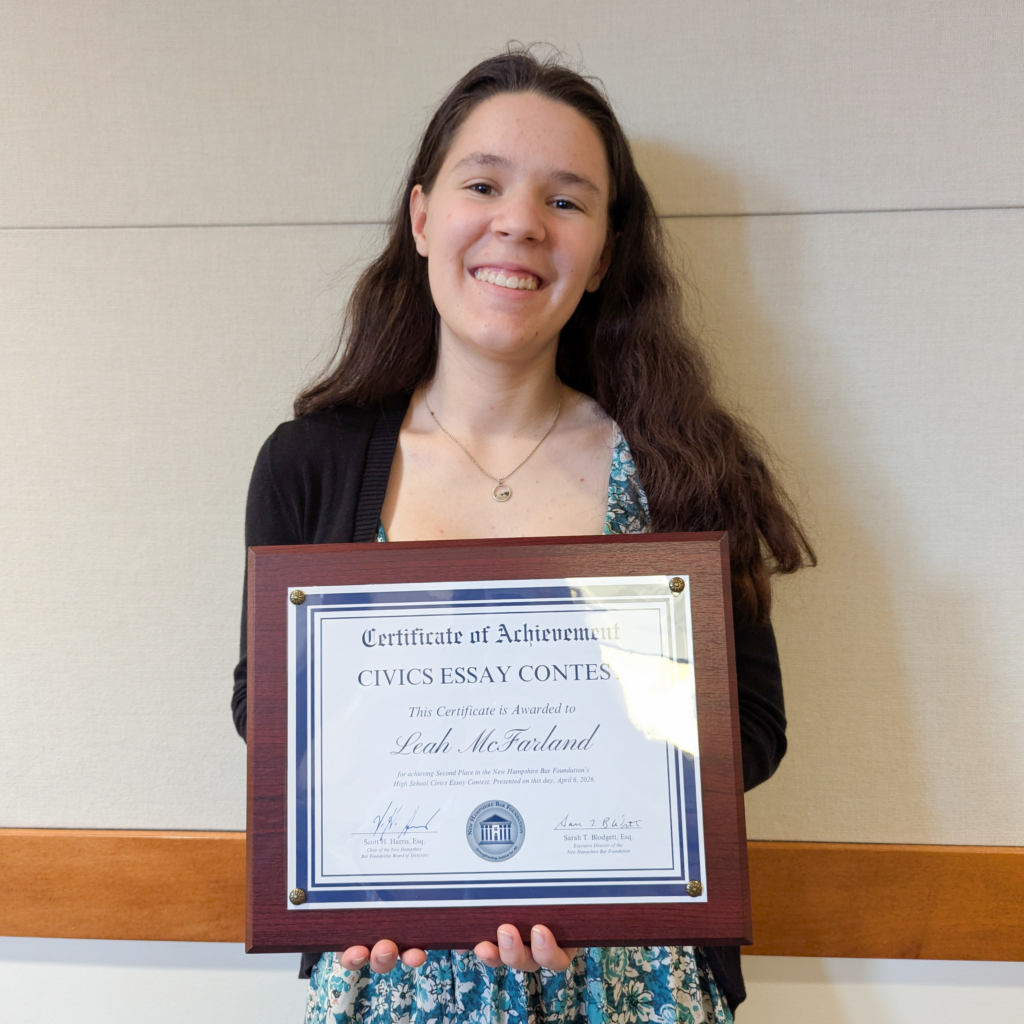
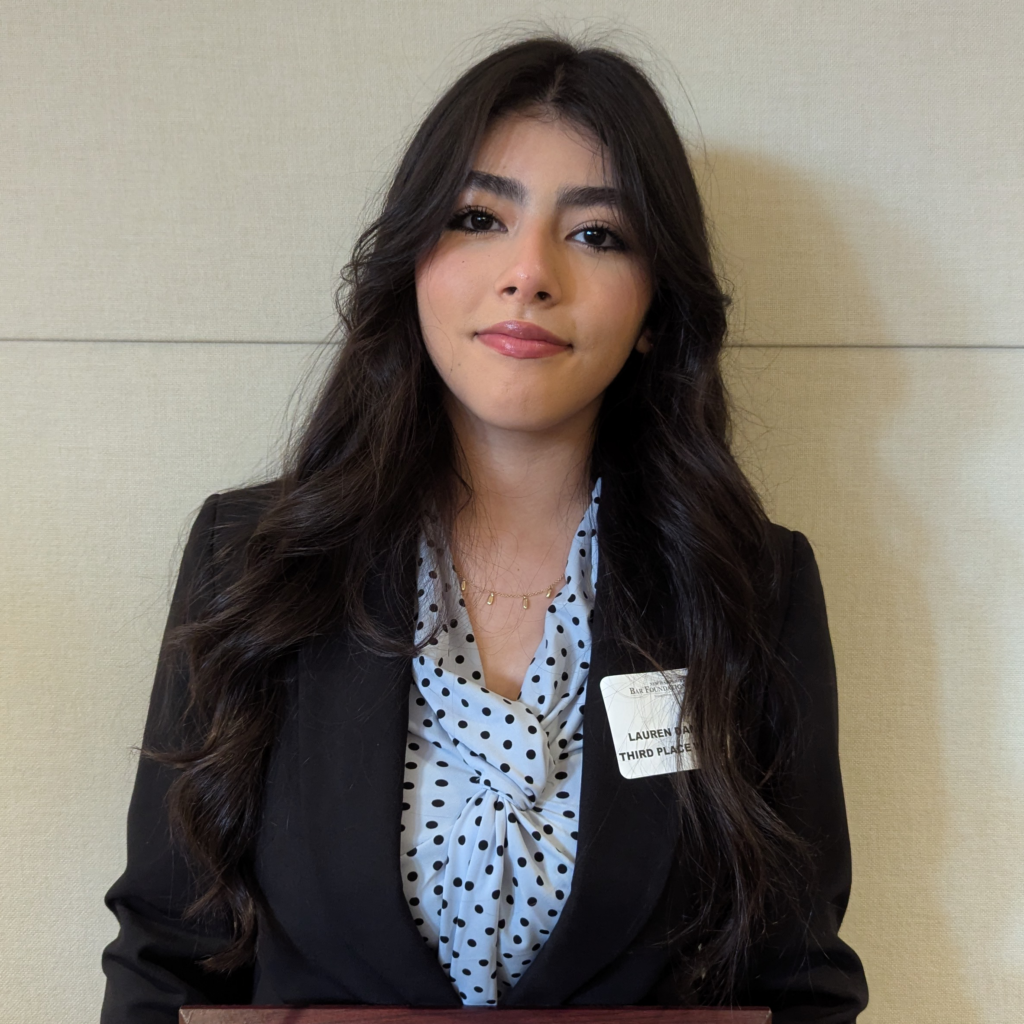
We invite you to view the award ceremony and the Union Leader coverage of the ceremony.
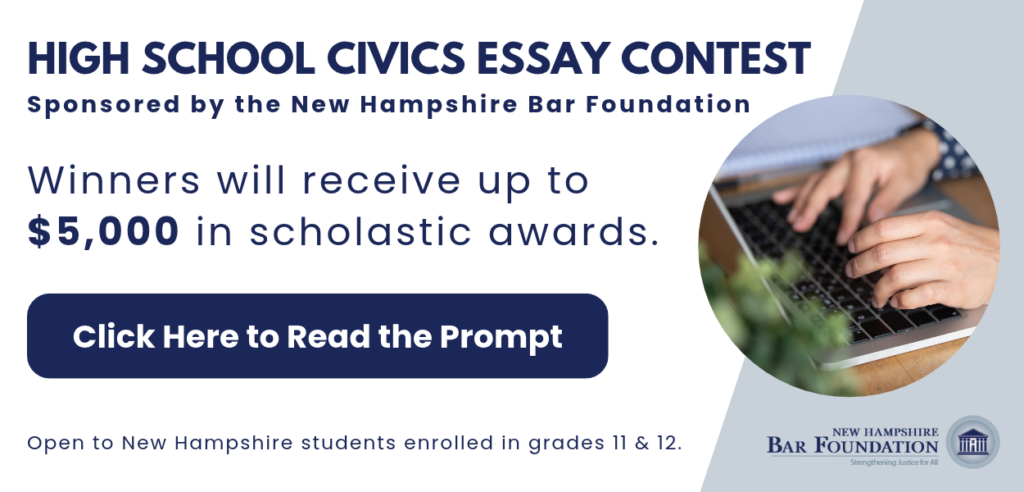
The New Hampshire Bar Foundation is pleased to announce its second annual high school civics essay contest. Students enrolled in grades 11 and 12 (or their equivalent) in the State of New Hampshire during the 2026-2027 academic year are invited to submit an essay based on the prompt below for the chance to win a prize of up to $5,000. The top 3 essays will be chosen in March by a panel of attorneys and judges. The author of the first-place essay will receive a $5,000 prize, while second and third-place winners will each receive a $2,500 prize. Check back for more details to be announced regarding ceremony date and location. All winning essays will be featured on the Bar Foundation’s website.
Essay Topic: You Be the Judge: Drafting a Court Order
Word Count: 750-1,000 words
Submission Deadline: February 5, 2027, at 5pm
Prizes: 1st prize: $5,000 cash, 2nd and 3rdprize: $2,500 cash
Each entry must include a completed 2027 Submission form (found within the essay contest rules), the Student and Parent / Guardian Release Form, and the Student Entry Form. Questions? Contact Cindy Roberts at croberts@nhbar.org or (603) 715-3210.
Essay Prompt
Contest Rules
Prompt Supporting Materials
Essay Prompt
Civics Essay Contest 2027: You Be the Judge: Drafting a Court Order
Open To: 11th/12th Grade New Hampshire students
Word Count: 750–1,000 words
Introduction & Context
The Eighth Amendment to the U.S. Constitution guarantees that “excessive bail shall not be required.” Because every citizen is legally presumed innocent until proven guilty, pretrial detention is meant to be an exception, not the standard rule. When a person is arrested for a federal crime, a U.S. Magistrate Judge holds a detention hearing shortly after the arrest. The judge must decide a critical question: Can this defendant be safely released into the community while awaiting trial, and if so, under what conditions? As the federal judge, you must balance individual constitutional liberties against public safety, the risk of interstate flight, and the integrity of the federal justice system. Under the Federal Bail Reform Act (18 U.S.C. § 3142), a federal judge must choose the least restrictive conditions necessary to ensure the defendant returns to court and does not obstruct justice.
The Case File: United States v. Marcus Clarke
- The Jurisdiction: Federal Court (U.S. District Court).
- The Charges: Interstate wire fraud (18 U.S.C. § 1343) and tampering with physical evidence (18 U.S.C. § 1512).
- The Allegations: The Federal Bureau of Investigation (FBI) alleges that Marcus Clarke, a 45-year-old corporate accountant, embezzled $45,000 from a local non-profit youth center over an 18-month period while he was serving as treasurer on their Board of Directors. To hide the theft, prosecutors allege he used wire transfers to route the funds into a bank account he established in another state. Federal investigators further allege he attempted to shred critical financial ledgers immediately after a surprise audit was announced
Defense’s arguments:
- Clarke is a lifelong Concord, New Hampshire resident with strong community ties.
- He is the primary caregiver for his elderly mother, who has dementia and lives in Concord. He visits daily to provide meals, check her medication, and take her to medical appointments.
- The prosecution is asking this court to violate the Eighth and Fifth Amendments by illegally detaining Mr. Clarke before his trial. Mr. Clarke is presumed innocent until he is proven guilty.
- Clarke is no longer employed, and his bank accounts are frozen. He would find it very difficult to pay to travel anywhere.
- When Mr. Clarke learned of the federal warrant, he didn’t flee to another state or overseas; he walked into the federal courthouse and voluntarily surrendered to marshals.
- He has no history of violent behavior and successfully completed all probation requirements for a misdemeanor DUI conviction five years ago.
- His prescription-forgery conviction occurred 20 years ago. The Government cites a missed hearing in that earlier case; the defense asks the court to weigh the age of that incident when assessing his present risk of non-appearance.
- If convicted of wire fraud and tampering with evidence, he is facing 18-30 months in jail. This relatively short amount of time in jail would not be a motivation for Clarke to flee his family, lifelong community, and country.
- Clarke admits he has a substance abuse problem and knows he needs continuing treatment for this disease.
- We ask for a personal recognizance release with strict conditions like passport surrender.
Prosecution’s Arguments:
- The Government requests detention of Mr. Clarke, as he is facing serious federal charges of wire fraud and obstruction of justice.
- This is a calculated, sophisticated crime where the defendant deliberately sent stolen non-profit funds intended for at-risk youth across state lines to conceal his actions.
- When a surprise audit was announced, Mr. Clarke ran to the shredder. If he is willing to destroy evidence to avoid accountability, we cannot trust his promise to return to court. Mr. Clarke is at risk of further destroying evidence to obstruct justice.
- Clarke poses a severe flight risk. He holds a valid passport and has traveled to Ecuador twice recently.
- Clarke missed a court hearing when he was facing the forging of prescription charges. He has a history of not showing up.
- $30,000 of the stolen funds may sit waiting for him in an out-of-state account. He has the financial means and the global experience to flee. A signature bond will not secure his appearance.
- Clarke needs to be detained until his trial to ensure he does not flee and has no more opportunities to alter evidence
Essay Requirements:
Your essay must be written in a formal, analytical tone befitting a court order and include the following clearly labeled sections:
- The Ruling: State your exact decision in the opening paragraph. Will the defendant be released on his own recognizance or detained in jail while awaiting trial? If he is released, what conditions would you impose on Mr. Clarke until his trial?
- Statutory Evaluation: Break down the four judicial factors under 18 U.S.C. § 3142. Analyze how the specific facts of Clarke’s case point toward or away from detention. a. Nature and Circumstances of the Offense
- The Strength of the Evidence
- History & Characteristics of the Defendant
- Danger to the Community/Justice System
III. Constitutional Balancing Act: Explain how your decision respects the defendant’s Eighth Amendment protections and Fifth Amendment due process rights while simultaneously protecting the community and upholding the integrity of the evidence and the judicial process.
- Final Justification: Defend why your specific set of conditions/your decision is the most appropriate, fair, and constitutionally sound outcome for this case. Why did you reject the alternatives proposed by the prosecution or defense?
You need only consult and refer to the following sources:
- The Fifth and Eighth Amendments to the US Constitution
- The Federal Bail Reform Act (18 U.S.C. § 3142
- Case law: S. v. Winegar, No. 20-mj-229-AJ (D.N.H. Feb. 4, 2021).
- Written laws: Interstate wire fraud (18 U.S.C. § 1343) and tampering with physical evidence (18 U.S.C. § 1512).
Please also review the Essay Contest rules.
Disclaimer that this is a work of fiction.
Essay Requirements
- Write a well-structured essay of 750–1,000 words, with an introduction, body paragraphs, and a conclusion.
- Ensure your essay is your own original work that reflects your thoughts and analysis.
- Take a clear position on whether AI companies should be required to compensate authors whose works they use.
- Discuss both sides of the argument, addressing the opposing viewpoint and explaining why your position is stronger.
Judging Criteria
- Essays will be judged on a 100-point scale, using the following criteria:
- Understanding of constitutional principles – 60 points
- Originality, clarity, and depth of analysis – 30 points
- Grammar, spelling, composition, and citations – 10 points
Contest Rules
NEW HAMPSHIRE BAR FOUNDATION
HIGH SCHOOL CIVICS ESSAY CONTEST
2027 CONTEST RULES
The contest is open to all New Hampshire students who are enrolled in grades 11-12 in public, private, parochial, charter schools located within the State of New Hampshire. The contest is also open to all New Hampshire homeschooled students of equivalent grade status.
Students should be mindful of the contest topic and should review the essay prompt carefully; essays not responsive to the topic will be disqualified from the contest.
Students (including homeschooled students) may submit essays directly to the New Hampshire Bar Foundation (Foundation). The name of a responsible adult familiar with their work (such as a teacher, guidance counselor, administrator, parent, tutor, or mentor) must be listed on the Student Entry Form.
Each student may only submit one entry.
Entries must be submitted via email no later than 5:00 pm on February 5, 2027. We highly encourage submission before that date to allow time for confirmation that submitted materials are complete. Late entries after 5:00pm will not be accepted.
Although a student may discuss essay topics and issues with parents, teachers, and others and read other non-AI sources for background information or generally to better understand the topics and issues, a student’s essay must be the student’s original work. A student’s essay must not be written, in whole or in part, by any person other than the student. Use of grammar and/or spell check software is permitted.
A student’s essay must not be generated, in whole or in part, by an AI tool or system (including, but not limited to, large models such as ChatGPT, Claude, or Gemini). A student may not use an AI tool or system to aid the student in any aspect of the essay contest.
If a student’s essay is found to have been generated or aided, in whole or in part, by an AI tool or system or written, in whole or in part, by any other person, the student’s essay shall be disqualified from the Essay Contest. The NH Bar Foundation and/or the Essay Contest judges have sole and final discretion regarding disqualification.
Any passages contained in a student’s essay paraphrased or quoted from other sources must be referenced in a “Works Cited” page in MLA or APA format. Failure to do so may result in the disqualification of the essay.
Email the essay, the Student Entry Form, the Student and Parent/Guardian Release Form and the 2027 Submission Form to nhbfessaycontest@nhbar.org. All forms must be received by the deadline to be eligible.
Criteria:
- Use of 12-point Cambria or Times New Roman font, double-spaced text with one-inch margins.
- Length must be between 750 – 1,000 words.
- Include page numbers. Do not include a title page or page headers or footers.
- Please save and submit the essay in PDF format. Submissions should be named as follows: First name Last name.pdf (example: John Smith.pdf). Each submission will then be assigned an identification number by the Foundation. This is so that entries may be screened and judged anonymously.
- Student’s name CANNOT be included in the essay itself.
- Any submission that includes identifying information (school, teacher/counselor, grade level, age, etc.) in the body or title of the essay will be disqualified.
- Essay submissions must include a completed Student Entry Form, a completed Student and Parent/Guardian Release Form, and a completed 2027 Submission Form to be considered. If all forms are not received by the deadline, the entry will be disqualified.
Prompt Supporting Materials
2027 Prompt Supporting materials
Activity in Case 1_20-mj-00229-AJ USA v. Winegar Order of Detention 2-4-2021 -1942930636 (002)