
By Tom Jarvis
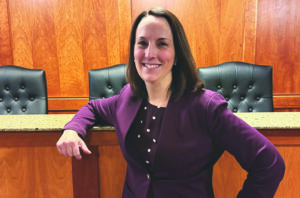 Courtney Brooks has been appointed interim dean of the University of New Hampshire Franklin Pierce School of Law (UNH Law), effective January 3, following the departure of Dean Megan Carpenter, who led the school for eight years.
Brooks has been at the law school since 2010 and serves as director of the Daniel Webster Scholar Honors Program (DWS Program) and associate dean for faculty. She will remain director of the DWS Program during her interim deanship.
“I’m excited,” Brooks says. “I care so much about the school, and I wanted to ensure continuity while advancing the school’s strengths, including its practice-based focus. This position presents completely different kinds of challenges than I’ve had before, so it’s an exciting opportunity to learn and to grow.”
The Path to Academia
A Colorado native, Brooks attended the University of Massachusetts Amherst, where she met her husband. She later moved to California and graduated from the University of San Francisco School of Law in 2001.
Brooks began her legal career in the Oakland office of Reed Smith, where she worked on pharmaceutical and medical device litigation, including many class actions. She moved to New Hampshire in 2004 with her husband and practiced at Pierce Atwood before joining Nixon Peabody in Manchester, where she worked on commercial litigation and financial services defense.
In 2010, after the birth of her daughter, Brooks sought a job with greater flexibility. A position opened at UNH Law as assistant director of externships, supporting placements intended to prepare students for practice.
“Around the time of the post-2008 recession, corporate clients began disallowing law firms to bill for new attorneys because they didn’t want to pay to train attorneys,” Brooks says. “And I thought, what a great way to start a different career in trying to get students practice experience while they were still in law school.”
She worked in the externship program for a decade before taking over as director of the DWS Program in 2020. She says working closely with students through the program’s practice-based curriculum has been “my biggest professional privilege.”
In July 2024, Brooks assumed the additional role of associate dean for faculty.
Immediate Priorities and Continuity
Brooks says the timing of the leadership change makes continuity a central concern.
“Priority number one is communication and assurance of stability,” Brooks says, referencing students, alumni, faculty, staff, and the broader legal community. She adds that the law school is also facing financial uncertainty as the main university changes its budget model.
“I will be looking at how we continue to be a viable and innovative institution in times of budget constraints,” she says.
Looking beyond the immediate transition, Brooks says one of the longer-term challenges facing legal education is what is often referred to as the “demographic cliff” – a projected decline in the number of high school graduates that will eventually reduce the pool of traditional college and law school applicants.
“There are far fewer students graduating from high school this year and next year,” Brooks says, noting that while the impact will take a few years to reach law schools, it will be felt most directly in traditional residential programs. “When we’re looking at our residential student population … that pipeline is just going to be a lot smaller.”
Colleagues on Brooks’ Leadership
UNH Law Associate Dean Michael McCann says Brooks brings a combination of institutional knowledge and communication skills to the interim role.
“Courtney is very thoughtful,” McCann says. “She understands academics in a very sophisticated way. She’s also an excellent communicator, very collegial, and works very well with all groups at the law school.”
UNH Law professor Sophie Sparrow, who has been at the law school for 33 years, emphasizes Brooks’ approach to leadership and collaboration.
“Courtney is incredibly smart,” Sparrow says. “She’s very thoughtful, and she listens to people, which is huge.”
Sparrow describes Brooks as “a patient, constructive leader,” a problem solver, and “very grounded and practical.”
“She’s also willing to admit when she’s wrong. She listens to other people. She recognizes that she doesn’t know everything,” Sparrow says. “I don’t know anybody in the school who doesn’t deeply respect and like her, and that’s somebody who can get a lot of things done.”
Anna Elbroch, director of UNH Law’s legal writing program, says Brooks’ work ethic and institutional knowledge stand out.
“Honestly, working with Courtney is a dream because she is such a hard worker,” Elbroch says. “She’s collaborative and knowledgeable about every aspect of the law school. To me, she embodies UNH Franklin Pierce’s practice-ready mission.”
Recognition from the Judiciary
New Hampshire Supreme Court Chief Justice Gordon MacDonald says Brooks is positioned to elevate the law school’s role in legal education reform.
“Courtney Brooks is perfectly suited to advance the law school’s national leadership in legal education,” he says. “I first came to know her as a highly skilled attorney when we practiced civil litigation together.”
He credits Brooks with strengthening the DWS Program and advancing practice-readiness initiatives nationally, including her work on the Conference of Chief Justices’ Committee on Legal Education and Admissions Reform (CLEAR) report earlier this year.
Chief Justice MacDonald also emphasizes the law school’s role in the state’s legal ecosystem.
“The law school has also long played an invaluable role in New Hampshire’s legal community, including through its clinics and public interest programs,” he says. “I have no doubt that under Dean Brooks’ leadership, that commitment will remain as strong as ever.”
Looking Ahead
Brooks says continuing to lead the DWS Program during her interim deanship is central to maintaining stability.
“When I met with the provost about the position, I said I really felt it was important to me and to the program that I continue,” Brooks says, adding that the university system recognizes the program’s value to the school and to the state.
Brooks says she also wants to build on the school’s practice-readiness approach by expanding it across programs, while recognizing that students pursue a wide range of career paths.
“Can we expand that type of practice-ready education students gain in the DWS Program to more students within our population?” Brooks says, adding that ensuring students in the school’s hybrid JD program are equally prepared for practice is a priority.
At the same time, she says preparing students for practice requires broad exposure to different areas of the profession.
“Maintaining a diversity in courses, programming, and faculty and staff, as well as a variety of counselors to help them pave those pathways, is critical,” Brooks says. “But exposure to different types of practice is also important, whether that’s through lawyers coming to the campus to speak about what they do or through internships and externships. Making sure that we’re always providing a variety of opportunities for the students is the best path for that.”
Connection to the Bar
Brooks says her experience practicing law in New Hampshire continues to shape her approach to legal education.
“I feel very connected to the New Hampshire Bar,” she says. “I loved practicing in New Hampshire, and being an educator in New Hampshire has been such a privilege. I am looking forward to continuing the connection between the law school and the Bar. That’s an exciting piece to me.”
UNH Law officials indicate that details about the timing and process for a permanent dean search are expected in the coming months.