
By Scott Merrill
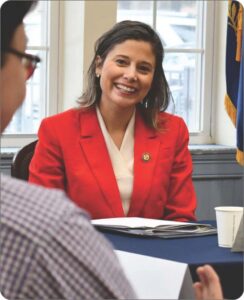
When Maggie Goodlander was sworn in last January as the US Representative for New Hampshire’s Second Congressional District, her first term quickly drew national attention.
Last November, Goodlander was one of six congressional leaders with military and intelligence backgrounds who released a video reminding US troops that they are duty-bound to refuse illegal orders.
The lawmakers – including Elissa Slotkin (D-Mich.), Senator Mark Kelly (D-Ariz.), Representative Jason Crow (D-Colo.), Representative Chris Deluzio (D-Pa.), Representative Chrissy Houlahan (D-Pa.), and Goodlander – cited concerns about potential unlawful maritime strikes. Following the release of the video, President Donald Trump criticized the lawmakers and called for charges to be brought against them.
Federal prosecutors subsequently presented the matter to a grand jury. In February, the grand jury declined to return indictments against any of the lawmakers.
“It was extraordinary that 23 ordinary American citizens in a grand jury – an institution that returns indictments more than 95 percent of the time – rejected the abuse of power,” says Goodlander. “We’re a country in which we generally trust our government. We trust that law enforcement is acting in good faith and enforcing the law.”
The investigation centered on 18 U.S.C. § 2387, a federal statute that criminalizes efforts to interfere with the loyalty, discipline, or morale of the US armed forces. The law prohibits advising or encouraging members of the military to engage in insubordination, disloyalty, mutiny, or refusal of duty, and also bars distributing materials urging such actions. Violations can carry penalties of up to 10 years in prison and temporary disqualification from federal employment.
The statute has rarely been used in modern federal prosecutions. Historical cases include United States v. Pelley in 1947 and United States v. Spock in 1969, both arising from anti-war activism during the Vietnam era. In more recent decades, prosecutors confronting similar allegations have more commonly relied on other federal statutes, including conspiracy laws or provisions of the Espionage Act.
The failed indictment also underscores the historical dynamics of the federal grand jury system. Grand juries, composed of panels of 16 to 23 citizens drawn from the community, decide whether prosecutors have established probable cause that a crime occurred. Unlike trial juries, which determine guilt beyond a reasonable doubt, grand jury proceedings occur in secret and require only 12 votes to issue an indictment.
For decades, the process has been widely viewed as heavily tilted toward prosecutors. In 1985, former New York Chief Judge Sol Wachtler famously remarked that a determined prosecutor could persuade a grand jury to “indict a ham sandwich.” Federal statistics reinforced that perception. In 2010, prosecutors presented more than 162,000 cases to grand juries nationwide, and only 11 failed to result in indictments.
The United States Department of Justice did not issue a formal explanation after the grand jury declined to indict the lawmakers. The Office of the US Attorney for the District of Columbia, led by Jeanine Pirro, later indicated that the case would not be pursued further.
Goodlander characterized the episode as politically motivated and an attempt to chill congressional speech, while some critics argued the rhetoric crossed a line.
“This has been such an outrageous and unprincipled case from the very beginning, and it’s hard to predict where it will go,” says Goodlander. “We’ve never seen anything quite like this. The president directed the Justice Department to investigate us, to prosecute us. He said we should be hanged. And the Justice Department followed through on pursuing criminal charges for a restatement of the bedrock principle of American law … for doing our jobs.”
Although she arrived in Congress as a freshman, Goodlander is no newcomer to Washington. The Nashua native is a graduate of Yale University and Yale Law School, and previously clerked for then-Chief Judge Merrick Garland on the US Court of Appeals for the DC Circuit and for US Supreme Court Justice Stephen Breyer.
She later served as deputy assistant attorney general in the US Department of Justice’s Antitrust Division and advised US senators on foreign policy and national security matters. Goodlander also served for more than a decade as an intelligence officer in the US Navy Reserve, reaching the rank of lieutenant.
Before running for Congress, she held a senior role in the Biden White House helping lead the administration’s “Unity Agenda.” Goodlander now represents New Hampshire’s Second Congressional District and serves on the House Armed Services Committee and the Small Business Committee.
Reflecting on the investigation, Goodlander says the episode highlights the power federal prosecutors possess in the grand jury process.
“Federal prosecutors are the most powerful peacetime force in our country because they have the power to investigate and, almost all the time, to issue indictments,” she says. “It’s an uneven playing field by design, where the government presents its case without the participation of anyone else involved. So, they really run the show, and this was even more extraordinary. This was a publicly available 92-second video in which we repeated a basic principle of law that Attorney General Pam Bondi repeated in a brief to the United States Supreme Court just a few months ago.”
Despite the outcome, Goodlander says she believes the underlying message of the video remains important.
“We decided after the Second World War that we want to be a country in which our military follows the law and does not just blindly follow orders,” she says. “That’s what makes us who we are as Americans.”