
By Tom Jarvis
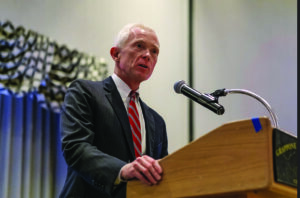
Gordon J. MacDonald resigned as chief justice and as a justice of the New Hampshire Supreme Court on September 15 after admitting that his handling of a Judicial Branch personnel matter violated three provisions of the Code of Judicial Conduct.
The resignation took effect immediately after a specially assigned panel approved a stipulation between MacDonald and the New Hampshire Judicial Conduct Committee (JCC). The agreement ended an inquiry that began in November 2025 and concerned MacDonald’s actions involving Dianne Martin, a senior Judicial Branch employee.
In a letter to Governor Kelly Ayotte, MacDonald wrote that he believed resigning was in the best interests of the Judicial Branch.
“I accept responsibility and accountability for my conduct,” MacDonald wrote. “It has been an honor to serve the people of New Hampshire.”
The personnel matter involved Martin’s 2025 removal as director of the Administrative Office of the Courts and her subsequent appointment as general counsel for the Office of Bar Admissions. The change allowed Martin to receive nearly $50,000 for accrued leave, according to New Hampshire Public Radio’s reporting on the records.
The New Hampshire Attorney General’s Office subsequently reviewed the matter and found no evidence of criminal wrongdoing. Its review concluded, however, that the handling of the personnel change did not follow human-resources best practices. The JCC’s proceeding was separate from that review and addressed MacDonald’s obligations under the Code of Judicial Conduct.
Under the stipulation, MacDonald admitted violating Canon 1, Rule 1.2 by failing to act in a manner that promotes public confidence in the judiciary’s impartiality and failing to avoid the appearance of impropriety.
He also admitted violating Canon 2, Rule 2.5(A) by failing to perform his administrative duties competently and diligently in connection with “the characterization, processing, and public explanation” of Martin’s removal and reappointment. The stipulation states that MacDonald bypassed established Judicial Branch rules and procedures by offering Martin a position without the competitive, merit-based process required of other branch employees.
The committee’s records also state that an October 2025 Judicial Branch statement signed by MacDonald and Associate Justices Patrick Donovan, Melissa Countway, and Bryan Gould “did not accurately portray the process for Martin’s removal and rehire to a new position.” The records released in connection with MacDonald’s case do not make findings of judicial misconduct against the three associate justices.
The third admitted violation involved Canon 2, Rule 2.13(A). According to the stipulation and the Supreme Court’s final order, MacDonald failed to exercise his administrative appointment authority impartially and on the basis of merit and failed to avoid favoritism in connection with Martin’s removal and subsequent appointment.
By signing the agreement, MacDonald waived a public hearing before the JCC and his right to a de novo hearing before a judicial referee. He acknowledged that the committee would enter findings, based on clear and convincing evidence, that he violated the three provisions.
The committee concluded that MacDonald’s admitted conduct warranted formal discipline and referred the agreement to the Supreme Court for approval.
The specially assigned panel found that the committee’s factual findings were supported by the record and approved the agreement. Because MacDonald resigned from judicial office, the panel determined that no additional disciplinary action was available.
The panel consisted of retired Superior Court Chief Justice Tina Nadeau and Superior Court Judges Mark Attorri, Martin Honigberg, Lawrence MacLeod Jr., and James Kennedy.
The final order also requires MacDonald to reimburse the Administrative Office of the Courts for the attorney fees and expenses the JCC incurred in investigating and prosecuting the matter. Payment is due by December 31. The amount had not been disclosed as of press time.
MacDonald had served as chief justice since March 2021. Then-Governor Chris Sununu first nominated him for the position in 2019, but the Executive Council rejected the nomination on a 3-2 vote. Sununu nominated him again in 2021, and the Council confirmed him on a 4-1 vote. MacDonald previously served four years as New Hampshire attorney general, worked in private practice, and served on the Supreme Court Board of Bar Examiners.
He had been on medical leave since July 24. During that period, the court’s four associate justices assumed the chief justice’s administrative responsibilities.
“The Judicial Branch remains focused on carrying out its responsibilities to the public and ensuring that the work of the courts continues without interruption,” the Branch said in its September 15 statement.
Governor Ayotte’s office acknowledged receiving MacDonald’s resignation, which the Executive Council formally accepted September 16 without discussion. Governor Ayotte said she would begin reviewing potential successors in consultation with the state Judicial Selection Commission, according to NHPR.
She did not provide a timetable and did not rule out making a nomination before the November election. A nominee must receive approval from a majority of the five-member Executive Council.
No nomination has been announced as of press time.