By Tom Jarvis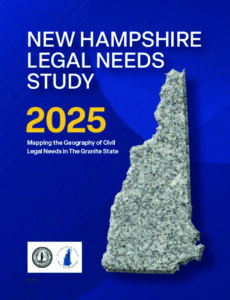
The 2025 New Hampshire Legal Needs Study, released in April 2026, provides a detailed picture of where civil legal needs arise in New Hampshire, where services are available, and where gaps remain.
The report found that demand for civil legal aid far exceeds available capacity, with more than 33,000 requests for help made to the state’s three primary civil legal services organizations between 2022 and 2024. Thousands of people could not be served because of limited staffing, program constraints, and intake barriers. Housing and family law matters accounted for much of the demand, while domestic violence matters, though fewer in number, remained among the most urgent.
The report also found that transportation barriers, limited internet access, disability, age, and geography can all affect whether residents are able to get legal help or meaningfully take part in court proceedings.
“Publication of the Legal Needs Study marks a turning point for how we understand access to justice in New Hampshire,” says New Hampshire Supreme Court Justice Melissa Countway, co-chair of the Access to Justice Commission. “The findings challenge us to think differently about how we measure access to justice and ensure that all Granite Staters, regardless of where they live or their unique circumstances, have a meaningful opportunity to be heard in court.”
The report was authored by Katherine Alteneder of Access to Justice Innovation and Suzanne Wade of More Than Maps. It was funded by the New Hampshire Judicial Branch and the New Hampshire Bar Foundation. 603 Legal Aid (603LA) served as the project lead, with significant data and collaboration provided by the New Hampshire Bar Association, Disability Rights Center-NH (DRC), and New Hampshire Legal Assistance (NHLA).
The study also drew input from 128 non-legal service providers, libraries, and community partners.
Using a geospatial approach, the report combines public demographic and infrastructure data, civil legal aid service data, court filing data, private Bar data, and community partner input to map where legal needs arise and where barriers to help are most acute.
“The Legal Needs Study makes clear that access to justice is not an abstract concept – it is shaped by where people live and the unique barriers they face,” says New Hampshire Supreme Court Chief Justice Gordon MacDonald. “By bringing together data from across our civil justice system, we now have a clearer understanding of where needs are greatest and how we can respond more effectively.”
603LA Executive Director Ariel Clemmer says the study provides data to support what legal aid providers have seen firsthand.
“The findings line up almost exactly with what we see at 603 Legal Aid, especially given our role as the state’s centralized intake hub for civil legal aid,” she says. “With this study, we have the data to back up what we have been experiencing on the front line for years. The volume of need, high-priority case types, and overwhelming number of people who can’t get help are now well-documented.”
Clemmer says the study shows how many eligible people are still being turned away.
“The most urgent finding is the gap between demand and capacity,” she says. “More than 60 percent of the 33,000 requests for help during this period were unable to be served. Many of those people qualified for legal aid but were turned away due to a lack of staffing and resources.”
The study identifies significant transportation and digital access barriers across New Hampshire, including more than 25,000 households without access to a vehicle and nearly 32,000 households without internet access. The report found that only about half of the state’s court locations can be reached by public transportation, with barriers most pronounced in the northern and western parts of the state.
Sarah Mattson Dustin, executive director of NHLA and vice president of the NHBA, says the study confirms both the scale of need and the importance of flexible service delivery.
“The study confirms what our staff see every day,” she says. “There is enormous need for civil legal aid, and the problems people face are often complicated by factors such as lack of access to transportation or inadequate digital connectivity.”
She adds that the findings also reinforce the need for flexible, tailored approaches.
“We can’t deliver one-size-fits-all services,” Mattson Dustin says. “One important theme in the study is that different regions have different advantages and disadvantages – ‘all justice is local’ – and, of course, every person is an individual with a unique mix of needs. We have to meet people where they are, and structure our work so that it is accessible to everyone.”
For DRC, the report highlights the extent to which disability intersects with poverty, geography, and access to court services. The study found that 178,623 people with disabilities live in New Hampshire – roughly one in eight residents – with disability rates especially high in parts of the North Country and other rural areas.
DRC Executive Director Stephanie Patrick says one recommendation that stands out is the expansion of remote court appearances.
“Many people with disabilities face transportation challenges and other barriers to getting to the courtroom,” she says. “Offering people the opportunity to participate remotely, if that’s what they choose and if the courts in New Hampshire are willing to consider it, is especially important for people with disabilities who may not be able to drive or otherwise get to the courthouse.”
The study also introduces a new measure called the Civil Legal Aid Coverage Coefficient, or CLACC, which compares civil legal aid involvement with court filing volumes. It found that legal aid reaches roughly 20 to 30 percent of eviction cases but only about one to three percent of consumer debt cases, with more limited and uneven reach in other areas. Court data cited in the report show nearly 40,000 small claims debt cases during the study period, followed by a 44 percent increase in the first quarter of 2025. Nearly half of those cases ended in default judgments.
Mattson Dustin says that measure was one of the study’s most notable features.
“The CLACC is a novel and interesting measure,” she says. “I had a general sense that civil legal aid has more of a presence overall in eviction work, but that trend is quite a bit starker than I realized.”
The report concludes with recommendations that include increased staffing for legal aid organizations, expanded non-lawyer and community-based assistance, greater use of remote and hybrid services, improved intake systems, digital support for users, and more limited-scope and Lawyer for a Day opportunities.
“Free legal help is essential infrastructure for strong communities,” says New Hampshire Access to Justice Commission Co-Chair Mark Rouvalis. “This report gives us the data we need to align resources with real-world need and make smart, strategic investments.”
The full study can be accessed through NHLA’s press release at nhla.org/blog/nh-legal-needs-study.