
By Tom Jarvis
Just over two years after fleeing Afghanistan and resettling in New Hampshire, Judge Geeti Roeen and her family are still adjusting to life in the Granite State – but the urgency of their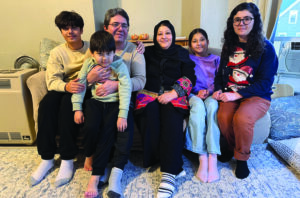 early days has gradually given way to something steadier.
When Judge Roeen, her husband, Dr. Ziaurahman “Zia” Roeen, and their three children arrived in New Hampshire in late 2023, they were starting over after years of displacement, including more than two years in a refugee camp in the United Arab Emirates (UAE). Today, the family has jobs, cars, children thriving in school, and professional goals that once again feel attainable.
“It was good to move to a new country, but it is also difficult,” Judge Roeen says, reflecting on their first weeks in New Hampshire. “We faced a lot of challenges, but after a few months there were fewer problems. We received a lot of help and support from the lawyers and judges in the Bar Association. For this reason, we did not feel alone.”
New Hampshire Supreme Court Justice Anna Barbara Hantz Marconi, who helped organize the resettlement effort, says the contrast between those early days and the present moment is striking.
“When the family arrived, everything was urgent,” she says. “Two years later, the urgency has shifted into stability. They are building careers, their children are thriving, and they are becoming part of the fabric of our community.”
From Shifting Sands
The Roeen family was forced to flee Afghanistan in August 2021 after the Taliban regained control of the country and banned women from serving as judges. Judge Roeen was among those particularly vulnerable, having presided over cases involving national security and violence against women and children. Through international evacuation efforts led by the International Association of Women Judges, Judge Roeen and her family were eventually brought to the UAE, where they remained in a refugee camp for more than two years before being resettled in New Hampshire with the help of the New Hampshire Coalition for Resettlement of Afghan Women Judges (the Coalition).
Circuit Court Administrative Judge Ellen Christo, who was present when the Roeen family first arrived by bus in Manchester, recalls how small details made the moment unforgettable.
“I remember helping wheel their suitcases into the hotel lobby, and how unimaginable it seemed that an entire family’s life could fit into a handful of bags,” she says. “What struck me most was how upbeat and happy they were, particularly the kids, who couldn’t wait to attend school.”
In the early months, nearly everything was unfamiliar – from navigating grocery stores to getting the children enrolled in school.
“When we arrived here, everything was new to us,” Judge Roeen says. “We had to find our way to stores and learn a new environment here. And I didn’t know any English other than how to say yes or no. Now I can speak more English, which helps a lot.”
Transportation was also a major hurdle. Both Judge Roeen and Zia later obtained New Hampshire driver’s licenses, requiring Judge Roeen to learn to drive for the first time – an experience she describes as initially scary but empowering. The family now has two vehicles – one obtained at a discount and another donated.
“Before we got our vehicles, it was a challenge, especially when there is snow, to walk 25 minutes to the supermarket and come back with all the bags while the cold wind was blowing,” Zia Roeen says. “But now we can drive there in five minutes.”
Professional Paths Restarted
Judge Roeen’s professional trajectory has begun to take shape. In 2024, she served as a visiting scholar at the University of New Hampshire Franklin Pierce School of Law and received an honorarium from Dartmouth College, speaking with students about her experience as a judge in Afghanistan and the country’s judicial system prior to the Taliban takeover. Budget reductions prevented an extension of the visiting scholar role, and for several months she was unemployed again.
More recently, she began working part-time as a teaching assistant at Alpha-Bits Learning Center in Manchester, with the possibility of transitioning to full-time work in the coming months.
She is also participating in an American Bar Association program for Afghan legal professionals, with the long-term goal of earning an LLM degree and eventually sitting for the New Hampshire bar exam.
“I applied to an LLM program for judges and lawyers from Afghanistan,” she says. “My documents have been accepted, but I have to pass the TOEFL [Test of English as a Foreign Language] first. The test is very hard.”
Judge Roeen is currently enrolled in three English classes, meets weekly with a law faculty member, receives tutoring through community volunteers, and is mentored by Circuit Court Judge Sandra Cabrera as part of the ABA program.
Zia, who practiced internal medicine and taught at Alberoni University in Afghanistan, is pursuing medical licensure in the United States. After arriving in New Hampshire, he began studying for the United States Medical Licensing Examination and passed the first step in September.
“That is the toughest of the series of exams,” he says. “Now I am preparing for step two. If I pass, I can apply for residency. After three years in residency, I can be a doctor in the United States.”
In the meantime, he has become licensed as a medical interpreter and provides interpretation services for hospitals and medical practices, while continuing to study.
Returning to the Courtroom
Through the support of her mentors, Judge Roeen has also had opportunities to observe court proceedings. The experience has been both encouraging and emotional.
“When I arrived the first time in the court here, suddenly it became a very difficult feeling,” she says. “I lost everything, so it is very difficult for me to think about sometimes. When I saw the judge sitting in front of the court, it made me remember my court and the cases I decided.”
Despite the initial emotional reaction, Judge Roeen says the experience was meaningful.
“They were very kind with me,” she says, noting differences between the Afghan judicial system and New Hampshire courts, including single-judge proceedings, juries, and remote appearances. “It was a very new experience. I learned a lot. I loved it.”
Judge Cabrera, who mentors Judge Roeen through the ABA program, says Judge Roeen’s judicial temperament remains evident.
“Her temperament is always so patient and understanding,” Cabrera says. “Every time she observes court, she looks elated. She says getting back into the court environment makes her excited to continue working toward her goals.”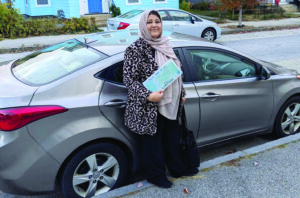
Thriving Children, Promising Future
Perhaps the most visible measure of progress is the Roeen children, all of whom are now fully immersed in school.
“When we arrived here, Kyomars was in seventh grade,” Zia says. “He has now graduated from middle school with a GPA of 3.92, and has received a bunch of awards, including the Principal Award. Mehrsa has also done very well and has good scores. She speaks excellent English and was given the Best Writer Award at school.”
Outside the classroom, Kyomars plays soccer, while Mehrsa has taken up music and now plays guitar. Their youngest child, Kyanoush, now in kindergarten, struggled initially due to language barriers but has since adapted. He now enjoys school and looks forward to going each day.
Community Support
Throughout the past two years, support from the legal community and local organizations has remained central. Zia recalls that Justice Hantz Marconi and Judge Christo were there when the family first arrived by bus in Manchester and have remained involved since.
“We had nothing when we came here,” Zia says. “They arranged for lawyers to help us with many things. They helped us with housing and rent, kids’ clothes, school things, and so much more. We have appreciated all their help so much. We haven’t felt alone here. They and the people who have been helping and supporting us are like our family.”
Christo says that for families arriving after years of displacement, even basic tasks can be overwhelming.
“When a family first arrives after fleeing everything they’ve known, they face an overwhelming list of practical tasks – finding their way in a new place, setting up utilities, figuring out where to buy food, or understanding how to use public transportation,” she says. “These are things people who grew up here take for granted. But for refugees, they’re part of learning how to live here, step by step.”
In addition to support from the Coalition, Brookside Church in Manchester has assisted with English instruction, employment resources, and practical needs.
During the past two years, the support effort has also become more formalized. The Coalition has affiliated with the New Hampshire Bar Foundation and established itself as a nonprofit organization, creating long-term structure and fiscal oversight for continued resettlement work.
Justice Hantz Marconi says what has unfolded over the past two years is difficult to fully capture, but inspirational.
“What they had to go through is hard to fathom,” she says, “but they have just taken to their new life with such incredible optimism – assimilating, embracing the culture, the opportunities, and thriving.”
A Future Taking Shape
The Roeens now describe New Hampshire as home.
“When we go to Boston, it feels like a long time driving there,” Zia says. “But on the way back, we feel very relaxed because this feels like home.”
He laughs that he likes to call it “New Hamp-SHIRE,” a nod to one of his favorite movies, The Lord of the Rings, and the sense of peace the family has found here.
Looking ahead, their goals are straightforward: professional stability, continued education, and the values they hope to pass on to their children. Judge Roeen says Kyomars has talked about becoming a doctor or an engineer, while Mehrsa has expressed interest in becoming a judge like her mother. Even their youngest, Kyanoush, has begun declaring himself “Dr. Kyanoush.”
“We are receiving help from others right now, but we are still independent,” Zia says. “One day we want to be able to give back and help others. We teach our children that we are getting help now, but someday it will be their turn to help people in need.”
Judge Roeen echoes that hope and adds:
“Compared to the past few years, we see a good future in a stable and peaceful environment. The future is bright.”