
By Scott Merrill
If the New Hampshire Constitution of 1784 is defined by anything as much as longevity, it is restraint – particularly around taxation and the concentration of power. Across nearly 250 years, repeated debates and constitutional conventions have left behind a fragmented historical record. Today, that record is being carefully reconstructed by an unlikely research team.
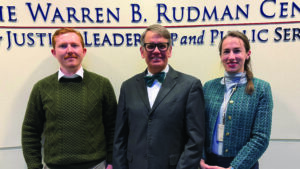
With support from the Warren B. Rudman Center for Justice, Leadership & Public Service (Rudman Center) at the University of New Hampshire Franklin Pierce School of Law (UNH Law), Bryan Rome, a second-year law student, and New Hampshire Superior Court Judge William Delker are assembling historical documents and newspaper accounts to trace the Constitution’s evolution and give judges and attorneys clearer historical context when interpreting its provisions.
“The current US Supreme Court is shifting a lot of decisions to state courts,” says Rudman Center Executive Director Anna Brown. “It follows that attorneys and courts in New Hampshire will more frequently consider arguments based on the New Hampshire Constitution. Providing the legal community with a detailed historical record of the legal arguments surrounding our state Constitution will enable stronger, more informed cases.”
Addressing Age-Old Questions
While New Hampshire ceded the title of oldest living constitution to Massachusetts, Rome takes that in stride.
“Unfortunately, Massachusetts has us beat,” he says, noting that New Hampshire has compensated through frequent reconsideration of its founding document. “Since independence, New Hampshire has convened 17 constitutional conventions, with the most recent one held in 1984.”
One of the most consistent themes in those debates is resistance to taxation.
“New Hampshire has never been a big fan of taxation,” Rome says. From the beginning, concerns about taxes and government power were embedded directly in constitutional language.
That skepticism persists. Rome points to Part II, Article 83 of the 1877 Constitution, which states: “No money raised by taxation shall ever be granted or applied to the use of the schools or institutions of any religious sect or denomination.”
As Rome notes, “You can kind of see the issue of religious schools and funding schools as something that just comes up again and again throughout history.”
That same impulse is paired with a fierce commitment to representation. “Hate taxation, love representation,” Rome jokes.
The dynamic helps explain the nation’s largest state legislature and repeated resistance to efforts to reduce it. Combined with its 24-member Senate, the New Hampshire General Court totals 424 legislators, making it one of the largest legislative bodies in the English-speaking world.
Judge Delker also points to two relatively recent constitutional amendments. One established a “Right of Privacy,” while another granted taxpayer standing to sue state or local governments over unlawful spending.
“It allowed taxpayers in certain situations to challenge government decisions, spending decisions,” Judge Delker says. “And that was a response to a state Supreme Court case that said taxpayers didn’t have a right to bring those kinds of lawsuits. And so, the voters responded.”
Separation of Powers
If taxation has been a recurring concern, the judiciary has been an even more volatile one. Judge Delker describes early court history as “a political football,” particularly in the decades after independence, when separation of powers was poorly defined.
That fluidity is embodied by Meshech Weare, New Hampshire’s first governor, who simultaneously served as legislative leader, chief executive, and chief justice – roles that would now be constitutionally incompatible.
Weare was also among the judges in the 1772 Pine Tree Riot trial, arising from resistance to British enforcement of laws reserving large white pines for Royal Navy masts. Though the defendants were convicted of assaulting a sheriff, the modest penalties were widely interpreted as tacit approval of resistance.
After independence, legislative dominance over the courts persisted. Lawmakers could remove judges not only by impeachment but by issuing a bill of address – effectively abolishing courts and reconstituting them with political allies.
“What they would do,” Delker says, “is issue a bill of address against all the judges, eliminate the court, create a new one, and then appoint their political supporters.”
The tactic was used repeatedly, especially during the Jacksonian era, undermining judicial stability. Rome notes that at times the chaos was extreme, with judges refusing to recognize legislative authority and rival courts operating simultaneously.
“A lot of the basic rules and procedures we take for granted today just didn’t exist,” Rome says.
A turning point came in 1818 with Merrill v. Sherburne, when the New Hampshire Supreme Court rejected the legislature’s practice of granting retrials. The court ruled that adjudication was an exclusively judicial function.
“That was a real line-in-the-sand moment,” says Judge Delker. “The separation of powers existed before that, but it wasn’t nearly as well-defined.”
Still, true judicial independence came slowly. Courts could be abolished outright until a 1966 amendment permanently established the Supreme Court as an independent constitutional body.
Origins and Purpose of the Project
For Judge Delker, the project began as a practical response to gaps he encountered on the bench. New Hampshire courts traditionally interpret state constitutional claims first, but when novel issues arise, historical guidance is often difficult to access.
“At the federal level, you have the Federalist Papers, Madison’s journals, all kinds of resources,” he says. “At the state level, we don’t have anything comparable that’s easily accessible.”
Those sources exist, but they are scattered across archives. Rome reached out to Judge Delker after independently noticing the same problem while attempting to assemble a pocket version of the Constitution, which has since been created by the Secretary of State’s office.
“I figured I could just try to put together a version and maybe print it out,” Rome says.
While working through the text, Rome noticed entire provisions labeled simply as “repealed.”
“If you know what words were taken out,” Rome says, “it can tell you a lot about what the people were trying to reject.”
“Bryan reached out to me because he knew I taught state constitutional law,” Judge Delker says. “He had this idea about the pocket constitution, and I said, yes, and let’s take it to the next level.”
Rome’s work now includes voter guides, pamphlets, and newspaper debates.
“This is so you don’t have to read years of different newspapers to understand what people were getting at,” he says.
One example involves a constitutional amendment affecting civil jury trials. Though presented as preserving the right, it raised the monetary threshold to access it. The Supreme Court later struck it down as misleading.
“That’s why voter guides are so important,” Rome says. “They show not just what passed, but how it was framed.”
Brown says findings like that underscore the project’s public value.
“I feel like [Rome’s] work with Judge Delker is protecting our history,” she says. “And to be clear, the New Hampshire Constitution has a very distinct history from the US Constitution. This is a document – and a history – worth cherishing.”
Looking Ahead
The work is slow and largely unfunded, supported mainly by the Rudman Center and in-kind assistance from the Supreme Court Law Library. The team hopes to partner with Oxford University’s Quill Project and eventually secure grants to digitize fragile materials.
For Rome, the project affirms the Constitution’s populist roots.
“Most amendments aren’t about special interests,” he says. “They’re about real people trying to protect their ability to live their lives.”
Judge Delker sees reassurance in the record. Deep divisions have surfaced before, yet the system endured. As major anniversaries approach, the project aims to ensure those debates are no longer lost to time.
Editor’s Note: At the upcoming Midyear Meeting on February 20, Judge Delker will be presenting a CLE, “The Important Work of Building and Structuring the New Hampshire Constitution” and will take part in a CLE panel discussion, “Why History Matters to the 21st Century Lawyer.”