
By Tom Jarvis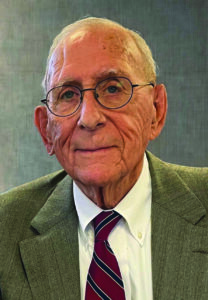
Jack Middleton, a towering figure in New Hampshire’s legal community whose career encompassed trial practice, judicial service, Bar leadership, and mentorship, died September 8. He was 97.
Middleton was the Granite State’s oldest practicing attorney and had recently marked his 70th anniversary with McLane Middleton.
Middleton’s legacy is marked by professional excellence, integrity, generosity, and an unwavering commitment to service. Generations of attorneys revered him as a mentor, colleague, and friend, and his legacy cannot be measured solely by the cases he tried, the organizations he led, or the honors he received. It can also be found in the encouragement he offered, the standards he set, and the countless personal acts through which he helped others find their own places in the profession.
“There are people we meet in our lifetime, and the moment we meet them, we know we are meeting someone special – that was Jack,” McLane Middleton attorney Jennifer Parent says.
Born in Philadelphia in 1929, Middleton grew up in Narberth, Pennsylvania, and graduated from Lafayette College in 1950. He served on active duty in the US Marine Corps and remained in the Marine Corps Reserve until 1959.
His connection to New Hampshire began in the White Mountains. During college, he spent three summers working for the Appalachian Mountain Club in Tuckerman Ravine. After his military service, he returned to the AMC and later spent a year as a weather observer at the summit of Mount Washington.
In 1953, Middleton entered Boston University School of Law, later serving on the Boston University Law Review. He graduated cum laude in 1956 and that same year joined the Manchester firm then known as McLane, Carleton, Graf, Green, and Brown. In 1962, he became a partner and would later serve as the firm’s president.
Middleton developed a wide-ranging trial practice that included civil litigation, personal injury, labor and employment, education, land use, and other matters. Among his most significant cases was Wooley v. Maynard, the 1977 US Supreme Court case challenging New Hampshire’s requirement that motorists display the state motto, “Live Free or Die,” on their license plates. Middleton served as trial counsel for George Maynard, whose objection to displaying the motto resulted in a landmark compelled-speech decision.
He also represented NEA-New Hampshire, the state’s largest educator union, in early teacher, labor, and school-funding cases and served for 24 years as a part-time New Hampshire district court judge.
Retired New Hampshire Supreme Court Justice Carol Ann Conboy joined McLane in 1979 and worked with Middleton on litigated cases for 13 years before leaving the firm for the bench. She describes him as “truly a master of the profession.”
“His commitment was first and foremost to excellence,” Conboy says. “Such excellence included an exquisite sensitivity to the ethical obligations that all lawyers vow to uphold. In demanding the highest level of performance from himself, he conveyed that demand to his associates and partners alike.”
Conboy recalls that Middleton worked well into the night preparing for the next day of trial, yet somehow made the work appear effortless.
“He was the most ‘efficient’ cross-examiner I ever saw,” she says. “He never wasted a question. His calm demeanor belied the punch behind each question. This, of course, can be accomplished only through thorough preparation.”
McLane Middleton attorney and former New Hampshire Bar Foundation chair Scott Harris had a similar view of Middleton’s courtroom abilities.
“He was a keen tactician who would make his point and sit down in a way that I haven’t seen before or since,” Harris says. “People feel the need to keep talking, but Jack had the confidence to know what he wanted to say and what he thought would be sufficient to win the case. He was a lawyer’s lawyer – or a trial lawyer’s trial lawyer – in my view.”
Middleton’s influence extended far beyond his own practice. He was one of the founders of the New Hampshire Bar Foundation and served twice as its chair from 2011 to 2018. He also served as president of the New Hampshire Bar Association from 1979 to 1980.
One of his most consequential contributions began at an American Bar Association meeting, where he learned about the nation’s first IOLTA program, established in Florida. Middleton brought the concept home, later explaining with characteristic understatement, “I brought it to New Hampshire by changing the word ‘Florida’ to ‘New Hampshire,’ and we just literally utilized it.”
With leadership from Middleton and the Bar Foundation, the New Hampshire Supreme Court adopted Rule 50 in 1982, making New Hampshire the second state in the country to operate an IOLTA program. Since its inception, the program has provided more than $44 million in grants supporting civil legal services and law-related education, including a record $2.5 million awarded for FY 2027.
Harris recalls Middleton’s continued dedication to raising money for those efforts.
“His energy and commitment to raising funds for civil legal services were quiet but unrelenting,” Harris says. “Jack would have a huge stack of those notes in front of him because he knew nearly everyone in the Bar. Unlike the rest of the folks who were sending out 10 or 15 letters, Jack would send out like 60 and get results.”
Former Bar Foundation chair James Tenn worked with Middleton for years on the Foundation board, served as co-chair with him, and later succeeded him as chair. Tenn says Middleton’s involvement did not end when his formal leadership role did.
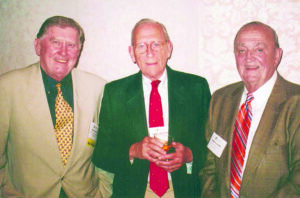
“Jack never truly stepped away from the Bar Foundation,” Tenn says. “Throughout my time as chair of the Foundation, Jack continued to offer guidance, ideas, and strategic thinking to continue to push the Foundation to achieve its goals.”
That continuing involvement came with what Tenn describes as “an encyclopedic memory” for Foundation history and details.
To honor Middleton’s extraordinary contributions to the state’s legal community, the Bar Foundation has renamed its Nixon Zachos Award the Nixon Zachos Middleton Award. Middleton, himself a past recipient, now joins David Nixon and Kimon Zachos in the award’s name, which recognizes the three attorneys’ leadership and service to the profession throughout New Hampshire.
For Tenn, Middleton’s legacy can also be seen in the example he set for generations of New Hampshire lawyers.
“He provided a road map for other New Hampshire lawyers to positively impact the lives of so many,” he says.
Middleton’s leadership also reached well beyond the Granite State. He served as president of the New England Bar Association, the National Conference of Bar Presidents, and the National Conference of Bar Foundations. His national service included more than 20 years in the ABA House of Delegates, six years on the ABA Board of Governors, and three years as ABA secretary.
Tenn’s relationship with Middleton began long before their years together at the Bar Foundation. As a new lawyer at McLane in 1991, Tenn says he was among the many young attorneys Middleton encouraged and mentored.
“All of us who were mentored by Jack are lucky,” Tenn says. “We benefited from his keen intellect, uncommon kindness, and his desire to leave things better than he found them.”
Parent saw that same generosity in the way Middleton created opportunities for others. She says he did more than model good leadership from a distance; he actively helped others find their own paths in the profession.
“He was always in my corner, helping me to forge my own path by supporting me, encouraging me, and championing me forward even when I didn’t yet know I was ready myself,” she says. “He’s the reason I got more involved in the American Bar Association.”
Parent says Middleton consistently supported women lawyers and looked for ways to help attorneys at every stage of their careers, whether by making an introduction, recommending someone for a board, or bringing a young lawyer to an event.
“Jack’s beneficiaries are many, and every one of us carries a piece of what he gave us forward,” Parent says.
Harris says Middleton’s guidance was “never heavy-handed but always clear in its direction.” He often taught through stories, including one from his Marine Corps service about reaching Camp Lejeune for reveille with only 10 minutes to spare after experiencing car trouble. Instead of praising Middleton for arriving on time despite the obstacles, his commanding officer told him, “Next time, you’ll think of starting earlier.”
Harris says the lesson was clear: Deadlines required planning, and arriving at court on time was never negotiable.
“There are countless examples I could give about Jack’s mentorship through story and through subtle message that influenced probably hundreds of people in the Bar over time,” Harris says.
Middleton brought the same commitment to civic life, serving in leadership roles with the Mount Washington Observatory, Mount Washington Commission, Greater Manchester Chamber, Manchester United Way, New Hampshire Public Television, New Hampshire Public Radio, the Business and Industry Association, and several conservation organizations.
His many other honors included three NHBA awards recognizing his distinguished service to the legal profession and the public, the National Conference of Bar Presidents Fellows Award, the New Hampshire Business and Industry Association Lifetime Achievement Award, and the University of New Hampshire’s Charles Holmes Pettee Medal.
At a celebration of Middleton’s 95th birthday, McLane Middleton attorney Bill Glahn recalled that Justice David Souter had once described Middleton as “New Hampshire’s representative to everything.” The description captured both the breadth of Middleton’s service and the remarkable number of people and institutions that benefited from it.
Yet those closest to him remember the small gestures as clearly as the prominent positions. Parent recalls that before she left for a hearing, deposition, or ABA conference, he would say to her, “Go get ’em, Tiger.”
When Conboy left McLane for the bench 34 years ago, Middleton offered a simple reassurance: “Carol, if you decide you don’t like being a judge, you can always come back to the firm.”
“I already miss him more than I can say,” Conboy says.
Parent says Middleton was, by any measure, an extraordinarily successful lawyer. But his accomplishments alone do not explain the affection and reverence he inspired throughout the legal community.
“If you ask people what they remember most, it’s rarely the cases or the accolades – it’s that he cared,” she says. “He cared about the people around him, about the McLane Middleton firm, and about giving back to the legal profession and the communities in which we live and work.”