By Megan Koerber
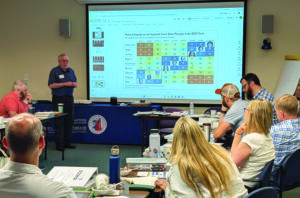
Fifteen New Hampshire educators gathered at the New Hampshire Bar Center on July 14 and 15 for a Street Law Professional Development workshop that combined United States Supreme Court education, hands-on learning, and lawyer-teacher partnerships aimed at strengthening civics education across the state.
Led by Street Law consultant and senior fellow Lee Arbetman and Senior Director of Teacher Professional Development and Curriculum Cathy Ruffing, the two-day program explored how the US Supreme Court operates, how constitutional cases are decided, and how teachers can bring those lessons to life in their classrooms through activities such as moot courts and collaborations with local attorneys.
The training reflects Street Law’s longstanding mission of making law and democracy accessible to students. According to Arbetman, the organization traces its roots to the Georgetown Law Center in 1972, when law students began teaching practical law lessons in Washington, DC, high schools. What began as an experimental clinical program has since grown into a global, nonpartisan, nonprofit organization focused on legal and civic education.
“In 2022, Street Law celebrated a half-century of educating people across the country and around the world about law, democracy, and human rights,” Arbetman says.
As Street Law’s classroom lessons gained popularity, the organization expanded its work with teachers. Its best-known educator initiative, the Supreme Court Summer Institute, was launched in 1995 and has brought teachers from across the nation, including New Hampshire, to Washington, DC, for intensive professional development focused on the Supreme Court and constitutional law.
“We know from that program and from surveying teachers in New Hampshire that there is interest in learning about the Court, its history, processes, and cases among secondary school social studies teachers in New Hampshire,” Arbetman says.
The New Hampshire workshop was designed to build on that interest. In addition to strengthening teachers’ understanding of the Court and Constitution, the program introduced participants to instructional strategies that can make legal concepts more accessible to students. Teachers were also given the opportunity to network with volunteer attorneys who will visit classrooms and assist with learning activities during the 2026–27 school year.
During the first day, participants explored the inner workings of the US Supreme Court through sessions led by Arbetman and Ruffing. Topics included the Court’s annual cycle, the certiorari process, and how justices analyze and decide cases. Teachers also participated in a deliberation exercise based on Mahanoy Area School District v. B.L.
Later that afternoon, participants took part in a moot court simulation based on Wolford v. Lopez. Working in teams, educators assumed the roles of Supreme Court justices, petitioners, and respondents. The simulation was supported by New Hampshire attorneys, including retired UNH Franklin Pierce School of Law Professor John Greabe, who coached the justices; Ted Lothstein of Lothstein Guerriero, who coached the petitioners; and New Hampshire Assistant Attorney General Sam Gonyea, who coached the respondents.
The first day concluded with planning sessions between teachers and volunteer attorneys, followed by a reception sponsored by the New Hampshire Bar Foundation.
At the reception, New Hampshire Supreme Court Chief Justice Gordon MacDonald spoke about his work with Pamala Custer, an educator at Hanover High School. Through that partnership, students in Custer’s Constitutional Law and Street Law classes spend a day observing oral arguments at the New Hampshire Supreme Court and ask the justices questions afterward about their roles and how the Court functions.
After the success of this initiative, Custer asked whether Chief Justice MacDonald would consider hosting high school student interns. That effort also proved successful, and the Court currently hosts two interns: one from Souhegan High School and one from Nashua High School South.
Chief Justice MacDonald also noted that the legal profession faces significant challenges, including the access-to-justice gap and declining public trust in institutions such as the courts. He observed that teachers are ideally suited to partner with lawyers and judges in addressing these challenges. Emphasizing that civics education can help rebuild public trust and inspire hope for the future, he drew on his own experience to encourage lawyer-teacher partnerships aimed at strengthening civic understanding and improving confidence in public institutions.
On the second day, educators continued practicing strategies they can use with students. Sessions examined the use of case studies in the classroom, including activities centered on Trump v. Barbara and Case v. Montana. Participants also explored Street Law’s extensive collection of free educational resources, including classroom guides for mock trials and moot courts, legal timelines, and landmark case materials.
The moot court simulation was one of the workshop’s highlights and offered teachers firsthand experience with legal reasoning and judicial decision-making.
Teacher evaluations completed after the workshop reflected the exercise’s impact. More than 85 percent of participants reported they were very likely to use a moot court activity in their classrooms, while 94 percent said the experience increased their understanding of the US Supreme Court. Several teachers expressed newfound confidence in bringing the strategy back to their students, and participants repeatedly highlighted the value of working with practicing attorneys during the simulation.
“This was the most topical, useful, and best professional development I may have ever had in 29 years of teaching,” one participant wrote in his evaluation.
The two-day program demonstrated the potential for stronger and longer-term partnerships between teachers and legal professionals. By bringing teachers and legal professionals together to explore constitutional issues, courtroom processes, and civic engagement, the Street Law Professional Development workshop not only expanded educators’ knowledge of the Supreme Court but also laid the groundwork for lasting partnerships that will benefit students across New Hampshire.