By Megan Koerber
As the United States marks its 250th anniversary, the American Independence Center (AIC) in Exeter is inviting visitors to think beyond 1776 and consider what independence, democracy, and the rule of law mean today.
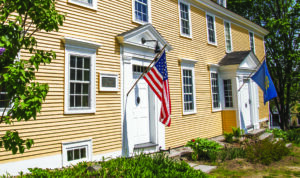
History is not just a topic to be discussed and studied, but something to interpret and apply in the present – a philosophy at the heart of the AIC. Located in the historic Ladd-Gilman House, the AIC is dedicated to preserving the nation’s past, and New Hampshire’s special place in it, as a way to foster ongoing civic engagement and a deeper understanding of America’s founding principles.
The AIC’s origins date back to 1985, when the Granite State’s original 1776 copy of the Declaration of Independence was discovered in the attic of the Ladd-Gilman House. Known as the Dunlop Broadside, the document was slated for auction by the property’s owner at the time, the Society of the Cincinnati (the Society). To prevent its sale, the State of New Hampshire intervened, and the Society ultimately agreed to establish a museum to preserve and display the document. That decision led to the founding of the AIC in 1991.
Superior Court Chief Justice Mark Howard had a personal connection to the case through his brother, Jeff, who was with the Attorney General’s Office when the state intervened. A self-proclaimed “history nut,” Judge Howard followed the case of the Dunlop Broadside and the development of the museum while he was in law school. Years later, when given the opportunity to connect with the AIC’s then-board president Joe Pace, Judge Howard jumped at the chance.
“Given what we do for a living in the judiciary,” he says, “we’ve devoted our lives to preserving, maintaining, and defining what it means to be an independent, free democracy – I think that those issues are fascinating, but they are also, for me, sustaining.”
Pace shifted from board president to executive director in March 2025, as the AIC was struggling to find someone to fill the position.
“My background and set of credentials, skills, and experiences made me who we were looking for … so I got kicked downstairs,” Pace jokes.
In planning its programming, the AIC aims to take visitors on a journey through American history by exploring how the ideals of independence and democracy have shaped the nation, with the larger goal of encouraging them to think and engage.
“We’re a center not just for passive museum visits, but interactive exhibits and civic engagement,” says Pace. “We don’t tell people what to think. We just encourage thinking.”
The newly opened Republic Room is designed to take visitors through the story of American history after the signing of the Constitution in 1787. The room includes information on Indian removal, suffrage, abolition, civil wars, and civil rights through the present day.
“This is America. It’s dirty, ugly, and funky,” Pace says, echoing language he says he once heard Cornel West use. “We are all part of this operation. It doesn’t work without us being informed, engaged, and active.”
The Folsom Tavern is another initiative where the AIC seeks to bring history to life through an immersive experience. The site is tied to local lore that George Washington enjoyed a drink there during his 1789 visit to the Granite State. Building on that atmosphere, the popular Beer for History series draws up to 40 visitors to the tavern for each event, where they sample brews from a local brewery while taking in a historical presentation.
“It’s a very genuine, very authentic experience,” says Judge Howard.
For the nation’s 250th anniversary, the AIC has launched a special initiative called Amending America. This 10-year partnership with the William W. Treat Foundation focuses on the Bill of Rights, with each year through 2035 highlighting one of the first 10 amendments to the United States Constitution. The series will explore the meaning of each amendment when it was drafted and compare that meaning with its modern interpretation.
“[We want to] challenge people not only to learn why these rights were included in the Bill of Rights,” says Pace, “but how jurisprudence and society have evolved to interpret them over the years and examine how they’re part of our lives now.”
Judge Howard adds that the AIC is also planning speaking events focused on the First Amendment.
“I can’t disclose who we expect to have – only because I want to make sure they’re fully committed to coming,” says Howard, “but they seem very excited.”
Pace emphasizes that as we look back with justifiable pride on “the expression of the American mind that is the Declaration of Independence,” we also need to study and understand it.
“I like to think of it as a sense of, to better understand where we are and where we’re headed, we go back and look at how we got started,” he says.
 In the spirit of looking back, an annual summer highlight in Exeter is the American Independence Festival, now in its 36th year. The AIC organizes the festival every year to coincide with the arrival of New Hampshire’s original copy of the Dunlop Broadside, brought by horseback on July 16, 1776.
The festival also includes a live reading of the Declaration (by a direct descendant of Nicholas Gilman, the original reader); local artisans practicing traditional 18th-century skills and crafts; colonial music, games, and interpreters; and a beer garden. The Dunlop Broadside will also be on display for a limited time.
But ultimately, for the AIC, events like the festival are about more than just entertainment. Pace and Judge Howard want those in the legal profession to know that they are integral to both the AIC and its mission.
“While we celebrate New Hampshire, we also celebrate the work that everybody in the legal profession does,” says Pace. “Because they’re helping to keep this thing on the rails. We’re all in this together. Everyone has a role to play and theirs is critical.”
Judge Howard hopes that with the support of the legal profession, the AIC will continue to grow in its mission.
“It’s more than just a house museum in Exeter,” he says. “It really has become a center for the study, preservation, and maintenance of independence in the US. And who better than the legal profession to be involved in that?”
Pace adds that they always need partners for programming and speaking events.
“So, if anybody reads this and goes, ‘Hey, that’s super cool and interesting,’ they can call me and learn more about it.”
Judge Howard wants everyone to be as fascinated with the study and interpretation of history as he is.
“I call on everyone to come out to the Center,” he says. “Admission is free – catch the same bug that I have!”
For more information on the AIC, visit aicnh.org.